Process design once done by hand by experts — now auto-generating up to 50 variant designs from a single PoC
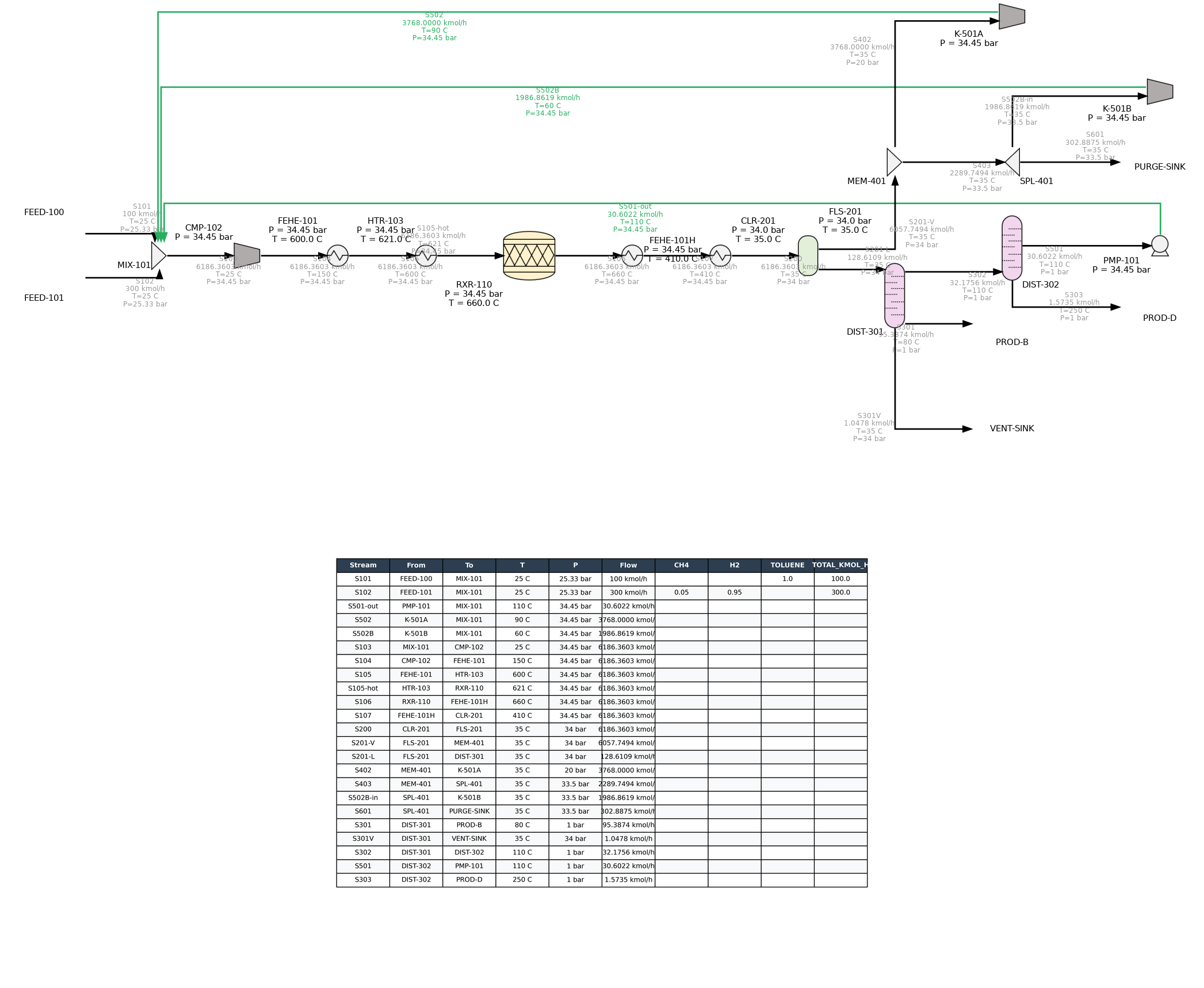
We implemented a chemical-process design methodology (the Douglas hierarchy) as an LLM multi-agent system, delivering a pipeline that runs from a problem-definition dialogue all the way to process flow diagrams (PFDs) and simulator input files — automatically.
- Client
- A national research institute
- Period
- H1 2026
- Role
- Design, build, and handover of an LLM multi-agent system
5–50
Variant designs auto-generated
89+16 nodes
Workflow scale
5
Independent RAG contexts
6
Design Pack artifacts
~95%
Data-contract consistency
The Problem
- Exploring process variants demanded skilled engineers' manual effort and long lead times
- The original goal was a PoC that auto-designed a single base case
Approach
- A conversational agent (16 nodes) queries feedstock, product specs, and constraints to produce a structured problem definition
- A 3-stage pipeline (89 nodes): logic filter → RAG-based combination agent (Quality-Diversity selection) → reactor/separation design agent with a self-repair loop → mass-balance validation
- Five textbook-grounded RAG contexts (vector search + reranking) record each design rationale down to its source (chapter/page)
- Expanded beyond the PoC scope into a production-grade pipeline
Systems Built
| Module | Description |
|---|---|
| Problem-definition chatbot | |
| Variant-generation pipeline | |
| Reactor & separation design agent | RAG + repair loop |
| Design Pack output | 6 artifacts: ProblemDef, DecisionLog, BuildSheet, FlowsheetSpec, AspenInput, PFD |
| Automated PFD rendering service | FastAPI, 21 process symbols, 3 render modes |
Screens
Tech Stack
n8nClaude (LLM)LangChainPineconeCohere RerankPythonFastAPIGraphvizAspen Plus integration